Are companies actually ready for AI?
Investing in AI feels relatively simple today. Signing a license, rolling out a tool, activating a copilot for your teams, that’s now a matter of days. The real work sits underneath, in the IT and business foundation all that AI needs to run on. And that’s where we keep seeing the same patterns with our enterprise partners.
The enthusiasm to get started with AI is high. The ambition is there, so is the budget. But as soon as a project really takes shape, it hits the same wall. The data isn’t quite right, it’s scattered across systems that don’t communicate well with each other, and no one can say with certainty which version of your customer database is the correct one. Or the information exists, but is buried under countless duplicates that make tracing it back to the source complicated. In short, it’s sometimes a mess, inconsistent and full of gaps, requiring significant cleanup work before you can actually get started.
Many organizations see AI today as a top-layer solution, something that makes data more visible and insightful. But AI doesn’t solve data problems, it exposes them.
An AI model is ruthlessly honest, it works with what you give it. Feed it a skewed, incomplete, or outdated picture of your organization, and you’ll get a skewed, incomplete, or outdated answer back. Often even presented convincingly, which doesn’t make it any better.
The layer structure: why the foundation determines everything
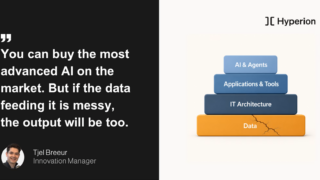
It helps to think of AI as a layered structure. At the top are the AI models and agents, the impressive, visible part that gets most of the attention today. Below that sit the applications and tools that AI is woven into. One layer further down is the IT architecture connecting these systems and the business processes that provide context. And right at the bottom, the broadest load-bearing part, lies your data landscape.
That bottom layer literally carries everything above it. If it’s unstable, it hardly matters how advanced the top layer is. A crack in the foundation works its way upward.
Tjel Breeur, innovation manager at Hyperion, puts the core point well: “You can buy the most advanced AI on the market. But if the data going into it is messy, so is the output.” It sounds logical, almost too logical, but in practice this order regularly gets reversed. Choose the AI first, then figure out how your data is structured and how it connects to the AI. That’s where many projects fail.
What’s more, this challenge is growing. AI is evolving from standalone assistants into agents that independently work through multiple steps and combine data from various sources. The more autonomy an application gets, the more heavily it leans on the quality and coherence of what lies beneath it. So the demands on your foundation keep rising too, at a time when boardrooms expect companies to become “data-driven.”
Data quality: why projects stall
In the same report, Gartner notes that many CIOs struggle to demonstrate the actual value of their AI investments. That’s no coincidence: AI projects that fail to deliver measurable results are almost always built on unstable ground.
The causes are familiar. Data sits locked away in silos, walled off by department or system. Applications built up over years of growth don’t communicate smoothly with each other. There are no clear agreements about who owns which data, and monitoring data quality is rarely anyone’s explicit responsibility, it’s more something that’s supposed to happen somewhere. And when no one explicitly owns it, it rarely gets done well.
As long as these things aren’t in order, every AI initiative remains an experiment. Sometimes one that succeeds by chance, often one that quietly disappears. But rarely something you can confidently scale across the rest of the organization. And scaling is exactly where the real value lies, where you move from an isolated pilot to actual business impact.
What an AI-ready foundation requires
The good news is that building such a foundation doesn’t have to be a mystery. It mainly requires tackling the right things in the right order, without getting distracted by the latest hype.
Start with a clear and complete picture of your current data landscape. Where does your data live, what state is it in, who uses it, and for what purposes? It sounds obvious, but many organizations simply don’t have that overview, or their understanding of it is outdated. That has to be your starting point.
From there, you build in structure. Breaking down silos so data flows instead of getting stuck. Making clear agreements on ownership, definitions, and quality standards. Mapping out an architecture that covers not just current needs, but also leaves room for tomorrow’s AI applications.
And above all, it requires a shift in mindset: treat data as a foundation, not a byproduct of your processes. Something you deliberately invest in before you invest in AI, not after. It’s not the work of a single sprint, and it won’t immediately produce a spectacular demo. But it’s exactly the work that makes the difference between AI that impresses on a stage and AI that adds value day in, day out in how your organization actually operates.
Now is the moment
2026 will be the tipping point where companies themselves invest heavily in AI. So the question is no longer whether you’ll join in, it’s whether your foundation is ready by the time you do.
At Hyperion, we see organizations taking this step every day. What stands out is that the companies getting the most out of it aren’t the ones with the biggest AI budget or the most advanced models. They’re the ones who got their data and architecture in order first, and only then started scaling. They went against the current while their competitors were already showing off the first tools.
Whoever invests in that foundation now won’t have to choose later between moving fast and doing it right. Both become possible.
Want to take the step together?
Reach out to us, and let’s explore how we can build future-proof solutions together. We’re just a message away!